Nepal Manuscripts Return Home After Conservation in Heidelberg
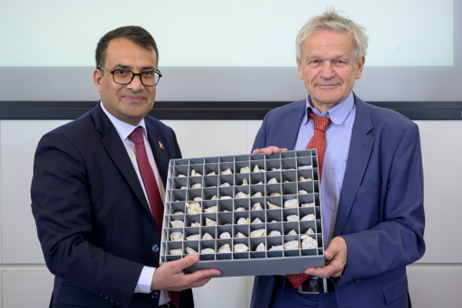
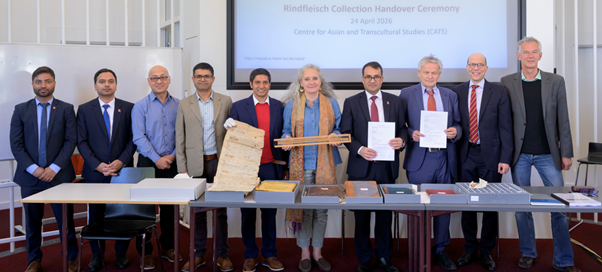
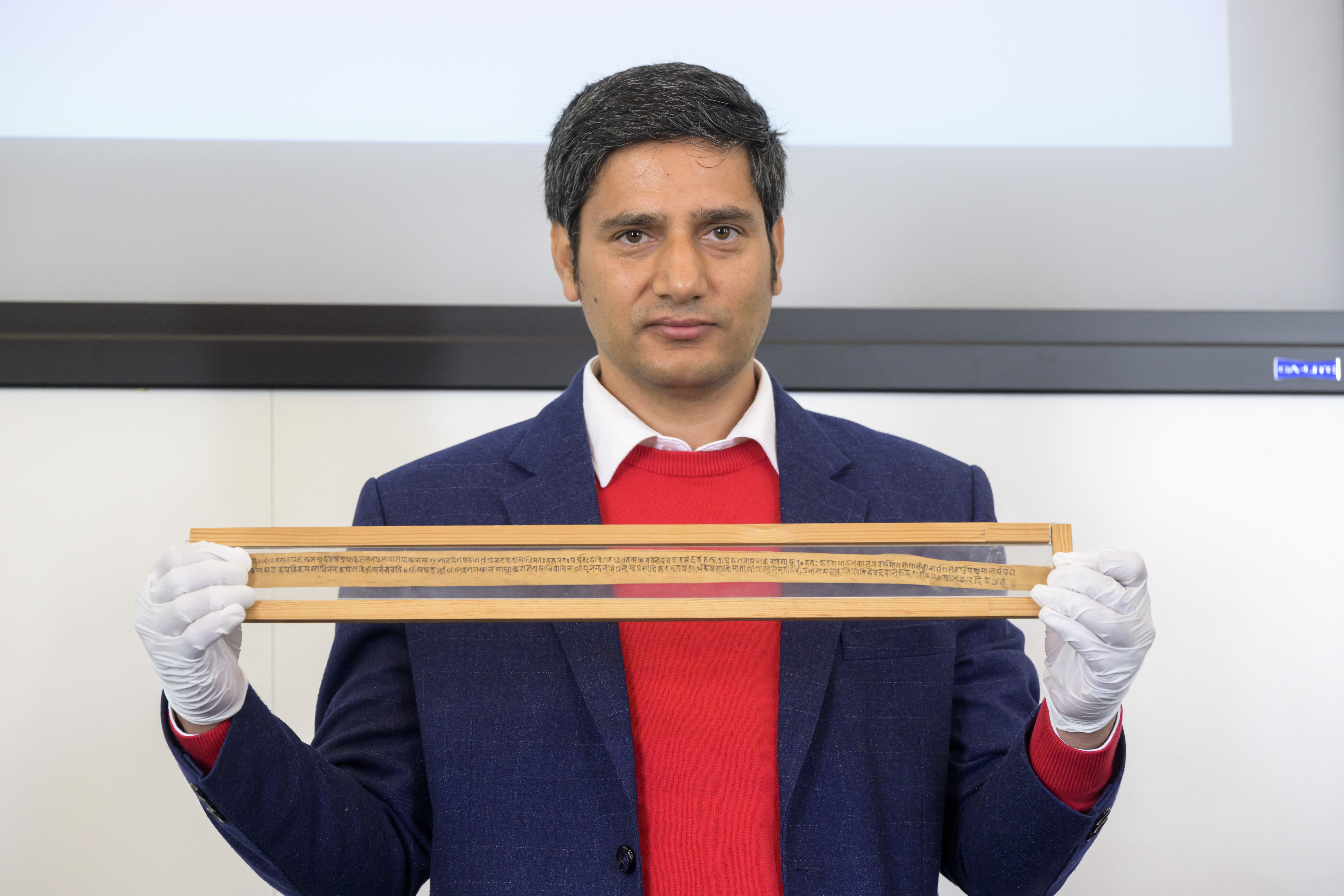
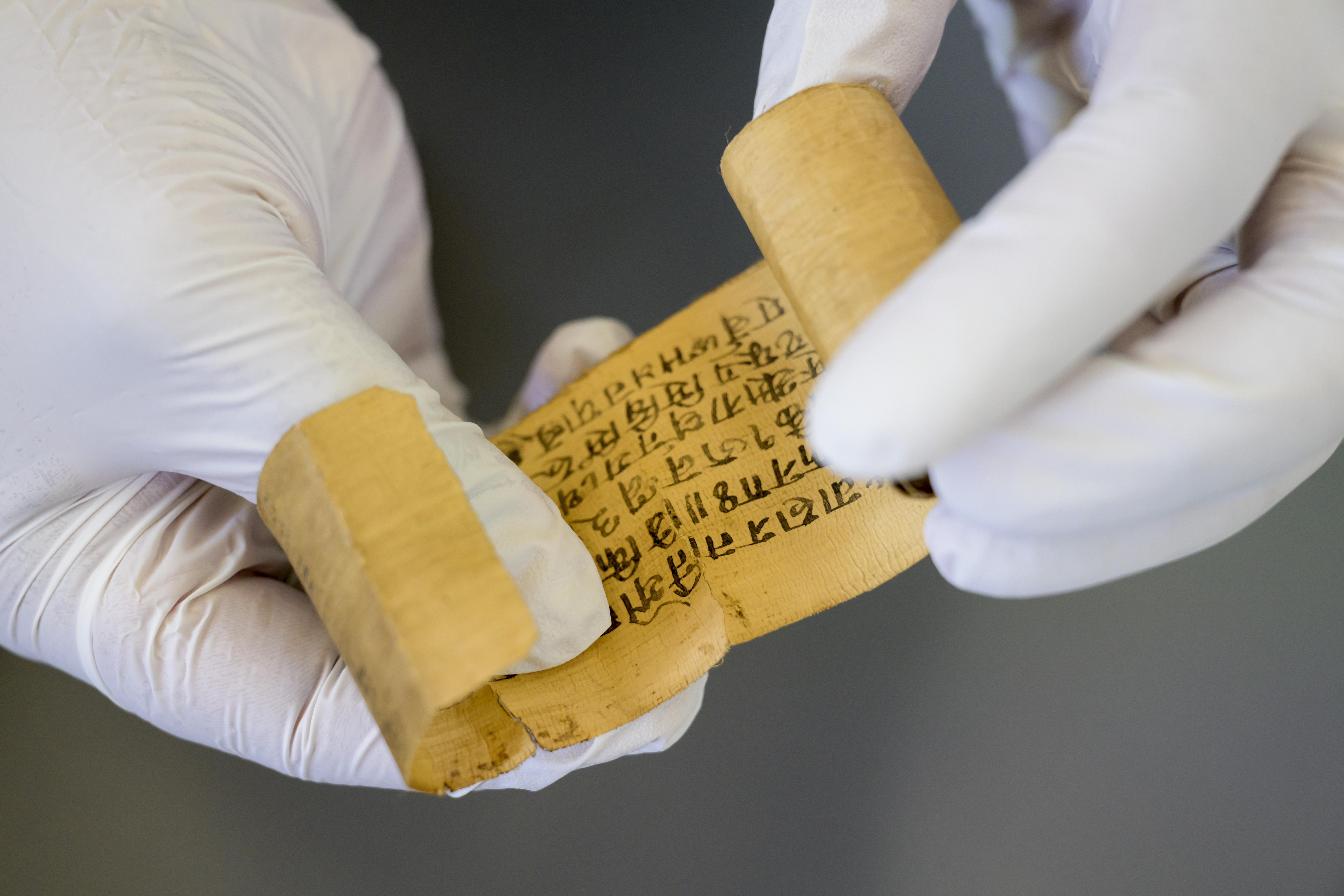
Photo Captions: Axel Michaels handing over one of the palm-leaf manuscript boxes during the handover ceremony — Photo by Philipp Rothe, 24 April 2026; Group photograph following the handover ceremony — Photo by Philipp Rothe, 24 April 2026; Rajan Khatiwoda showing a flattened palm-leaf scroll — Photo by Philipp Rothe, 24 April 2026; Unrolling a palm-leaf manuscript to demonstrate its format — Photo by Philipp Rothe, 24 April 2026.
A collection of rare manuscripts from Nepal, assembled by Bavarian collector Josef Peter Walter Rindfleisch between 1980 and 2000, had been entrusted to the Indologist Axel Michaels of Heidelberg University with the explicit aim of eventual repatriation. On April 24, 2026, representatives of the Nepalese government officially received the materials in a handover ceremony in Heidelberg. The agreement was signed by Sagar Phuyal, chargé d’affaires a.i. of Nepal’s Embassy in Berlin, and Axel Michaels.
Scholars consider the holdings to be one of the largest collections of Nepalese palm-leaf rolls outside Nepal. At its core are 465 Newari palm-leaf rolls, many bearing clay seals and dating to the medieval Malla period (c. 1200–1800). The archive also includes royal decrees, court records, Sanskrit manuscripts, and a wide range of historical materials—from legal and ritual texts to photographs, maps, and personal writings. Fifteen bound volumes document palace life, state expeditions, and official correspondence from the 19th and early 20th centuries.
“This collection offers a unique window into Nepal’s political, legal, and religious history across several centuries,” said Axel Michaels, who has led research on the materials at the Heidelberg Academy of Sciences and Humanities.
When the manuscripts arrived in Heidelberg, many were in poor condition, affected by mold, insect damage, and earlier repair attempts. Conservation specialists carried out extensive restoration: palm-leaf scrolls were humidified, carefully opened, cleaned, repaired, digitized, and rehoused in acid-free archival storage.
The project received support in 2022 from the Flagship Initiative Transforming Cultural Heritage (FITCH) at Heidelberg University, enabling systematic cataloguing and digitization. Today, the collection is accessible via the Heidelberg University Library and integrated into the Documenta Nepalica database. A free open-access catalogue with the metadata will soon be jointly released by the Heidelberg Academy of Sciences and Humanities and the National Archives of Nepal.
As part of the handover event, Dr. Manik Bajracharya and Dr. Rajan Khatiwoda presented selected documents from the collection. Both have been closely involved in the preservation, cataloguing, and scholarly study of the materials, as well as in supporting the practical implementation of their repatriation within the broader project framework.
A particularly significant role in this context was played by Prof. Dr. Christiane Brosius, Director of the Nepal Heritage Documentation Project (NHDP), who was instrumental in securing FITCH funding for the conservation and digitization of the Josef Peter Walter Rindfleisch Collection and has continuously supported the project through sustained academic engagement and public discourse in both Germany and Nepal. Alongside her, Prof. Dr. Simon Cubelić (now at Ludwig Maximilian University of Munich) played a crucial role in supporting conservation and digitization efforts and in advancing scholarly discussions on repatriation through academic forums.
Welcoming remarks were delivered by the Prorector for International Affairs, Prof. Dr. Marc-Philippe Weller, and Prof. Dr. Hans Harder, the speaker of the South Asia Institute.
Receiving the manuscripts, CDA a.i. Mr. Sagar Phuyal expressed sincere appreciation to Professor Axel Michaels and all those involved in the preservation and repatriation process, noting that the return reflects a deep respect for Nepal’s cultural heritage on an international level.
For Axel Michaels, the dual approach—digital access and physical return—was essential: “Making the materials available worldwide is one goal, but returning them to Nepal is equally important.”
With the handover now complete from the German side, a substantial body of Nepal’s written heritage has returned to the country—preserved for future generations and accessible to researchers and heritage lovers worldwide.