Exhibition on Buṅgadyaḥ: The Rain-Making God
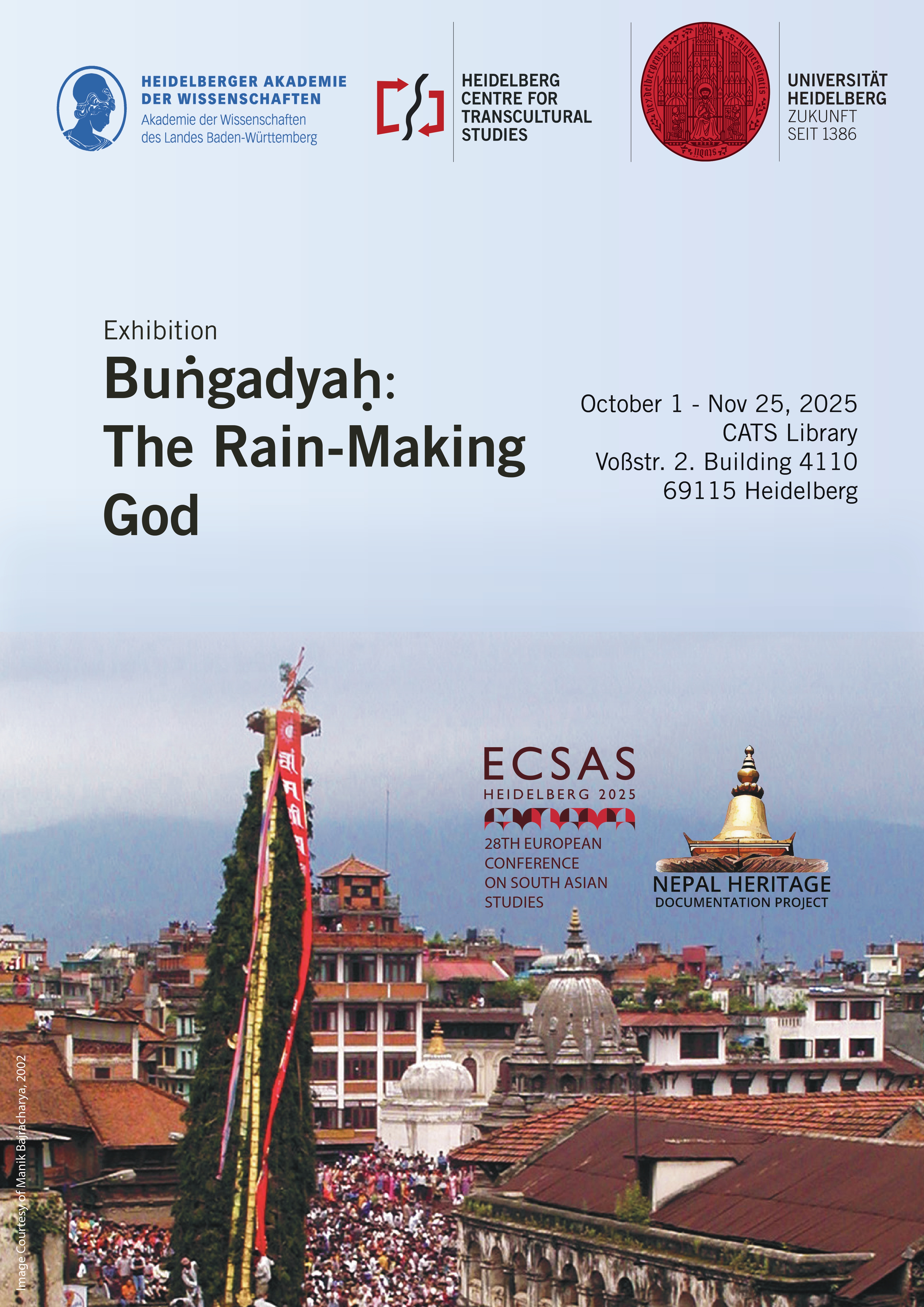
On 1 October 2025, the University Library Heidelberg (CATS branch) inaugurated an
important exhibition entitled Buṅgadyaḥ: The Rain-Making God, foregrounding one of the
Kathmandu Valley’s most vibrant and enduring ritual traditions — the Buṅgadyaḥ (Rāto Matsyendranātha) procession in Patan, Nepal. This exhibition was launched in conjunction with
the opening of the 28th European Conference on South Asian Studies (ECSAS), hosted in
Heidelberg from 1 to 4 October 2025 and provided a thematic anchor to the event’s broader
engagement with South Asian cultural practices.
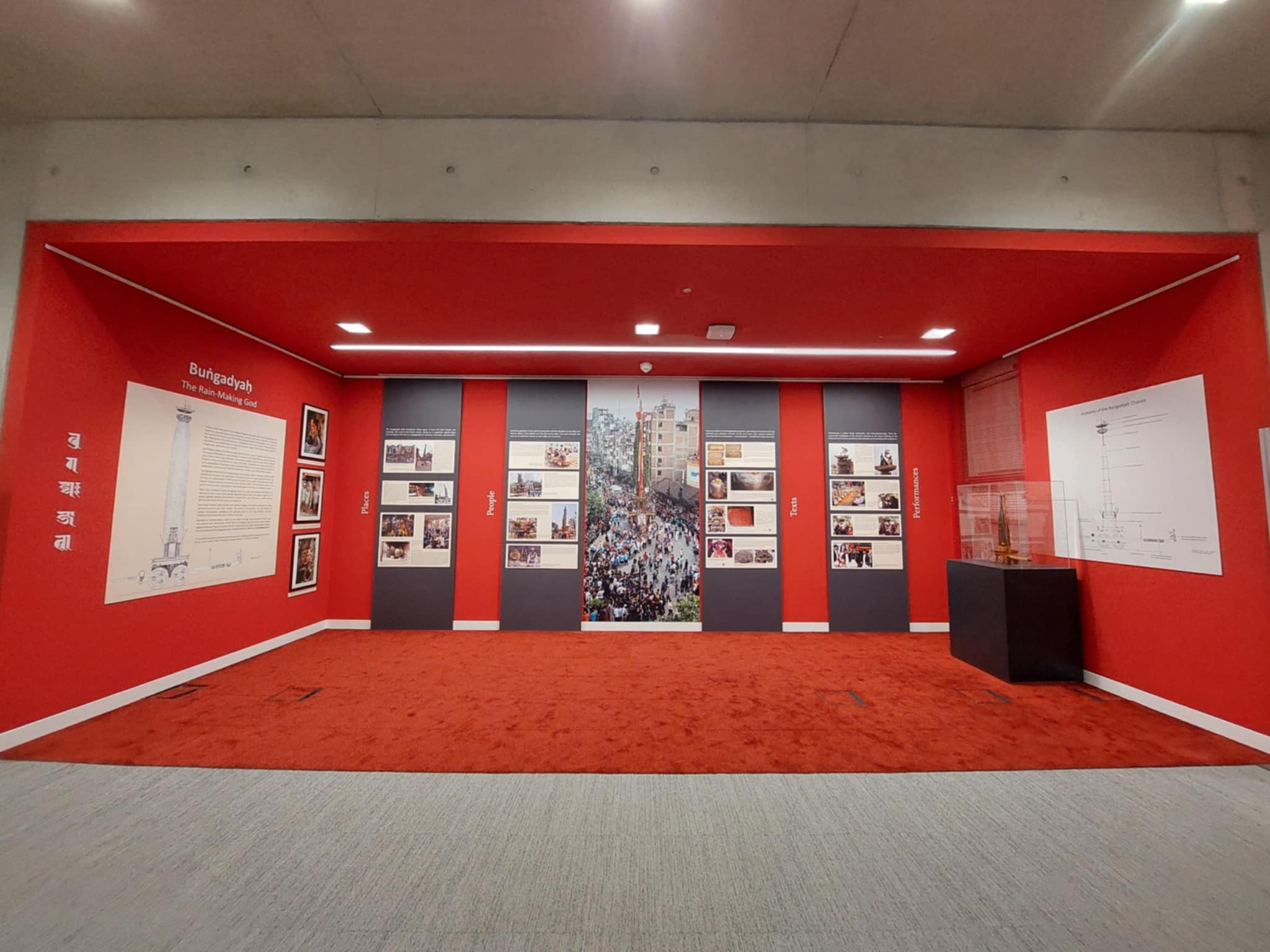
Drawing on rich archival and ethnographic material, the exhibition examines the Buṅgadyaḥ
festival not merely as a local custom but as a profound living heritage — a ritual cycle extending
over more than two months, in which the deities, artisans, ritual specialists, and city
communities co-produce meaning through collective enactment. The procession’s central
chariot, its ceremonial construction, the route through historic streets, the ritual offerings, and
the seasonal invocation for rain and prosperity are placed in dialogue with maps, historical and
contemporary photographs, fieldwork images, and audiovisual documents.
The curators assembled four interwoven themes — places, people, texts, and performances —
to highlight how bodily practice, spatial mapping, and textual memory intersect in the ritual life of
Patan. Central to this visual and analytical narrative were images by Bruce Owens, whose
historical photographs and observations significantly deepen the exhibition’s documentation of
ceremonial scale and urban context. These materials were shown alongside documentary film
footage produced by the Nepal Heritage Documentation Project (NHDP) that will be made
available as open access following the exhibition period.
The exhibition was conceptualized and curated by a collaborative team comprising Christiane
Brosius, Marion Wettstein, Manik Bajracharya, Simon Cubelic, Rajan Khatiwoda, and Monalisa
Maharjan, drawing on their sustained field research, archival work, and curatorial design. It
represents both an academic and a cultural-public intervention: inviting audiences to see the
Buṅgadyaḥ ritual as a nexus of historical depth, community knowledge, and ritual performance
that transcends static heritage categories. The exhibition offered visitors — conference
attendees, university members, and the wider public — a layered understanding of how
processional culture mediates seasonal rhythms, social cooperation, and cosmological
imagination in the Kathmandu Valley.